

Article
The Top 12 Luxury Travel Magazines in 2026
The luxury travel category is written about by fewer publications than the volume of coverage suggests. A handful of titles set the vocabulary, and the rest follow. The list below covers the twelve that matter most to anyone tracking how private travel is reported, whether you are placing a story, reading for ideas, or simply working out where the taste is being made. It is a working reference rather than a ranking, and it reflects the field as it stands in 2026, after a period of consolidation that removed several long-running names.
1. Condé Nast Traveler
The largest general readership in the category and the most consequential awards franchise in the Readers' Choice list. Coverage runs broad, from airline seats to private islands, but its hotel and villa reporting still moves bookings faster than anything else here. You can read Condé Nast Traveler online or follow the daily edit on Instagram, where it holds the largest following of any title on this list.
2. Travel + Leisure
Founded in 1937 and now published by People Inc., with a circulation around 950,000 and a World's Best Awards programme that hoteliers plan their year around. Editorially warmer and more service-led than its rival, which makes it receptive to practical stories about how private stays actually work. The full archive sits online, and the magazine is worth following on Instagram for its awards coverage in particular.
3. Robb Report
Founded in 1976 and owned by Penske Media, Robb Report is the reference title for the luxury category as a whole: yachts, watches, aviation, and travel treated as one continuous subject. If your reader charters, they read this. Robb Report publishes daily online and keeps an active Instagram feed of roughly 461,000 followers.
4. Condé Nast Traveller (UK)
Editorially independent of its American sibling and, for European villa coverage, more useful. The British edition writes about the Mediterranean with the specificity of people who go there, and its Gold List carries genuine weight with European operators. You can read it online or on Instagram, where the feed leans harder into design than the American edition does.
5. Elite Traveler
Distributed onboard private jets, which tells you everything about the readership. Smaller in reach than the mass titles and far more concentrated: the audience is the buyer rather than the aspirant. Strong on private aviation, yachting, and residences at the top of the market. Elite Traveler is available online and on Instagram, where its following is deliberately narrow.
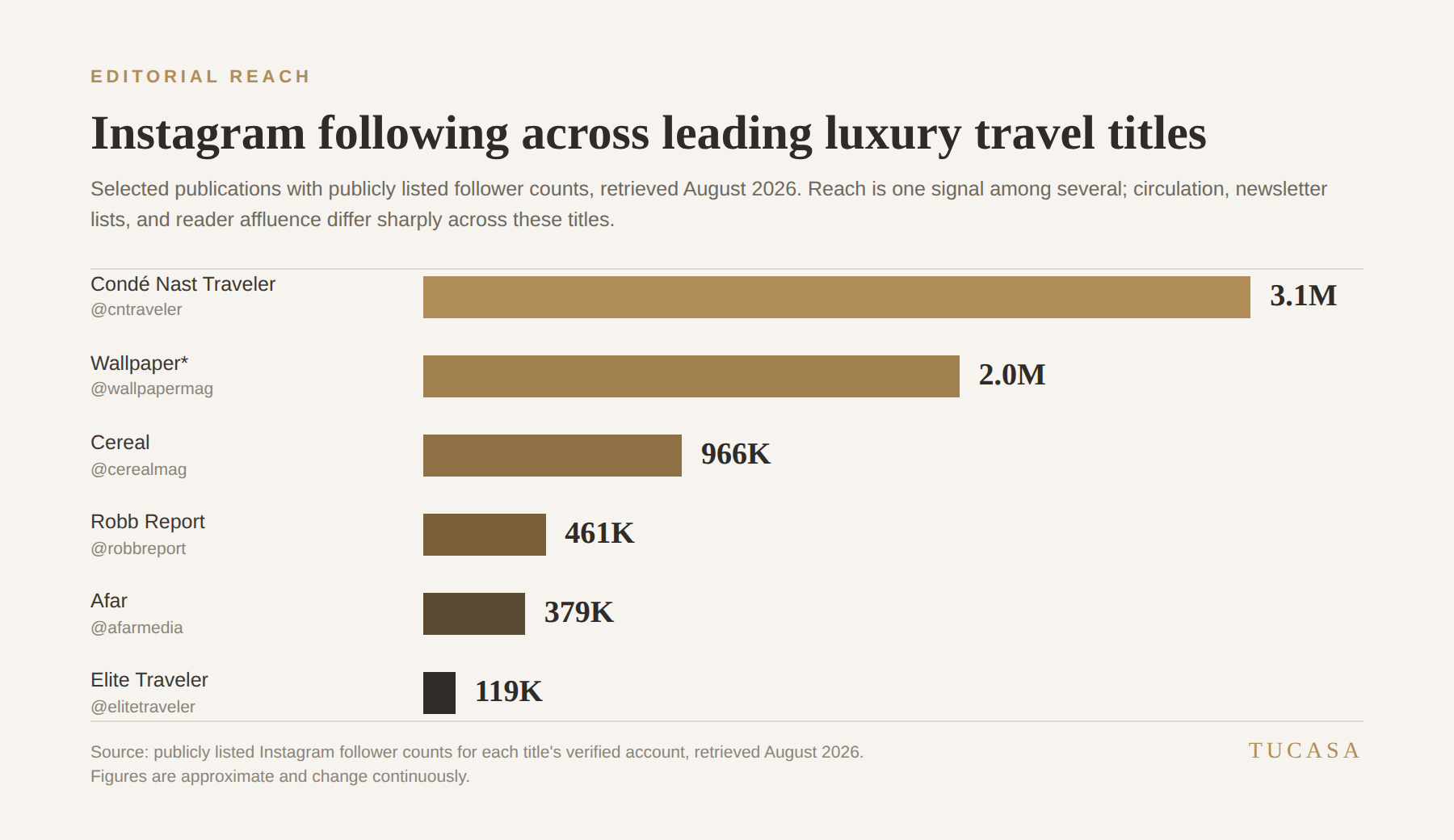
The spread above is worth reading carefully, because it is easy to misread. Condé Nast Traveler reaches roughly twenty-six times the Instagram following of Elite Traveler, and yet a placement in Elite Traveler will often produce more qualified enquiries for a private estate, because the readership is concentrated rather than broad. Cereal sits third on reach with a print run a fraction of the size of the titles beneath it, which says more about the value of a distinctive visual identity than about editorial scale. Follower counts measure attention. They do not measure intent, and in this segment intent is the only figure that matters.
6. Afar
Founded in 2009 around the idea that travel should change the traveller rather than simply reward them. It reports on luxury without treating expenditure as the story, and it has quietly become one of the more editorially serious titles in the field. Afar also acquired Suitcase following that magazine's 2023 insolvency. Read it online, or follow Instagram for its photography commissions.
7. Wallpaper*
Not a travel magazine, and that is the point. Wallpaper* covers architecture and design, and it writes about private residences with a rigour no travel title matches. For architecturally significant villas, this is the publication that understands what it is looking at. Its coverage runs online alongside a two million strong Instagram account that functions as a design reference in its own right.
8. Monocle
Founded in London in 2007 by Tyler Brûlé, who also co-founded Wallpaper*. Circulation is small, influence is not. Its travel arm, The Escapist, and its annual quality of life reporting shape how a certain kind of international reader thinks about where to be. Monocle sells subscriptions and its travel guides online, and posts on Instagram with the same restraint it applies in print.
9. Cereal
A biannual, independent, design-led title published from Bath since 2012 by Rosa Park and Rich Stapleton, who visit and vet every destination personally. Few pages per issue, very few destinations, and a following approaching a million. Selection is the entire editorial method, which makes it the closest thing on this list to a guide. Cereal publishes city guides and stories online, though its Instagram is where most readers meet it first.
10. Luxury Travel Magazine
The leading title in the Australian market, covering the Pacific, Southeast Asia, and long-haul European travel for a readership that books far ahead and stays longer than most. Useful for anyone whose villa calendar depends on the southern hemisphere summer. You can read it online and follow the editorial team on Instagram.
11. National Geographic Traveller (UK)
Published under licence in Britain and editorially distinct from the American edition. Less concerned with luxury as a category and more with place, which paradoxically makes its destination reporting some of the most useful available when you are choosing a region rather than a residence. The UK edition publishes online and maintains a separate Instagram account from its American parent.
12. Travel + Leisure Southeast Asia
Regional editions are where the fastest growth in luxury travel readership now sits, and the Southeast Asian edition is the clearest example. It covers Bali, Phuket, and the Thai islands with local knowledge the parent title cannot match. Read it online or on Instagram, where its following now rivals several of the global titles above.
Bonus: Five Major Publications With Serious Luxury Travel Desks
Some of the most influential travel writing in the world does not appear in a travel magazine at all. These five newspapers and business titles run dedicated desks whose reach and credibility exceed most specialist publications, and they are frequently the harder and more valuable placement.
- The New York Times. The Travel desk, and its annual 52 Places list, shifts demand for entire regions within days of publication. Coverage appears online, and the desk runs one of the largest travel accounts anywhere on Instagram, at around two million followers.
- Financial Times, HTSI. The FT's luxury lifestyle magazine, formerly How To Spend It, is arguably the best-read title among the ultra-high-net-worth audience in Europe, precisely because it arrives with the newspaper rather than instead of it. Published online and on Instagram.
- WSJ. Magazine. The Wall Street Journal's style and travel supplement, strong on design, collecting, and the intersection of wealth and taste. Available online and on Instagram.
- The Telegraph. Britain's most thorough newspaper travel desk, with a large stable of specialist correspondents and unusually detailed regional coverage of Italy, Greece, and Spain. Read it online or on Instagram.
- Bloomberg. The Pursuits section covers travel as an extension of business reporting, which produces sharper writing on pricing, ownership, and market shifts than most travel titles attempt. Published online, with wider coverage on Instagram.
What This List Says About the Coverage
Two absences are worth noting. Departures, American Express's title for Platinum and Centurion members, ended its United States print and digital publication in January 2024 after forty years, though an international edition continues. Suitcase, founded in 2012 and one of the sharper independent voices of the last decade, entered liquidation in 2023 and its title was subsequently acquired by Afar. The category has fewer independent publications than it did five years ago.
The second observation is more useful. Across all seventeen titles above, private staffed residences remain under-reported relative to how the segment actually travels. Hotels receive the awards, the rankings, and the annual lists. The villa, which is now where a large share of milestone travel happens, is covered episodically and rarely inspected. That gap is why we built Tucasa's luxury villa rentals collection around a vetting standard rather than a listing count, and why our destination reporting concentrates on the regions where private estates genuinely outperform what a resort can offer.
If you are planning around any of the regions these publications cover most closely, our destination collection spans the Mediterranean, the Indian Ocean, and the Americas.
Commonly Asked Questions About Luxury Travel Magazines
Which luxury travel magazine has the largest readership?
Condé Nast Traveler and Travel + Leisure are the two largest by circulation and social reach in the United States. Travel + Leisure reported a circulation near 950,000 in 2024, and Condé Nast Traveler holds the largest Instagram following of any dedicated travel title, at roughly 3.1 million.
Which publications matter most for villa rentals specifically?
Condé Nast Traveller UK and Travel + Leisure Southeast Asia for regional depth, Wallpaper* for architecturally significant residences, and Elite Traveler for reaching buyers at the top of the market. Among the newspapers, the Financial Times HTSI supplement and the Telegraph travel desk cover European villa stays most consistently.
Are any major luxury travel magazines no longer publishing?
Yes. Departures ended its United States editions in January 2024 after four decades, and Suitcase went into liquidation in 2023 before being acquired by Afar. Several regional editions have also closed or merged since 2020, which is why any list of this kind dates quickly.
What is the difference between a travel magazine and a luxury travel magazine?
Chiefly the reader, not the destination. General travel titles write for someone choosing between options at many price points. Luxury titles assume the reader has already decided, and devote their attention to distinction, service, and design instead. The best of them, Afar and Monocle among them, refuse the distinction entirely.
How do you pitch a luxury travel magazine?
Lead with a trend or narrative angle rather than a listing request, address a named editor on the relevant desk rather than a general inbox, and keep the first message short enough to read on a phone. Editors at these titles receive several hundred pitches a week, and the ones that succeed usually offer a story the writer could not have written without you.
Do these magazines accept paid partnerships?
Most do, through separate commercial teams, and several run branded content studios. Editorial and commercial are typically kept apart, so a paid placement will not usually lead to organic coverage. It is reasonable to ask about both in a first approach, provided you are clear about which you are proposing.
Which of these titles still publish in print?
Condé Nast Traveler and Traveller, Travel + Leisure, Robb Report, Afar, Wallpaper*, Monocle, Cereal, Luxury Travel Magazine, National Geographic Traveller UK, and the FT and WSJ supplements all continue in print. Elite Traveler remains distributed onboard private aviation. Print in this category has proved considerably more durable than in general interest publishing.
How often should this list be revisited?
Annually at minimum. Ownership changes, editor moves, and closures have reshaped the field twice in the last five years, and a list assembled from older sources will usually include at least one title that no longer exists.


