

Article
Is There Actually a Michelin Guide for Villas?
The short answer is no. The MICHELIN Guide assesses restaurants and, since 2024, hotels. It does not assess private villas, and no comparable independent body does either. That absence is the reason the search exists at all. Someone planning a milestone stay wants to know who inspected the villa, against which criteria, and what happened to the ones that failed. In luxury villa rentals, that answer has almost never been available.
What the MICHELIN Guide Actually Covers
The Guide has assessed restaurants since 1900 using anonymous, salaried inspectors who book under pseudonyms, pay for their own meals, and return across a year to test consistency. In an interview with Forbes, one inspector described a worldwide selection of roughly 15,000 restaurants, of which only about ten percent carry stars. The Irish Times, reporting on the 2026 Britain and Ireland announcement, notes that Michelin will not confirm its headcount, though the trade estimates the number at somewhere between 150 and 200 people worldwide.
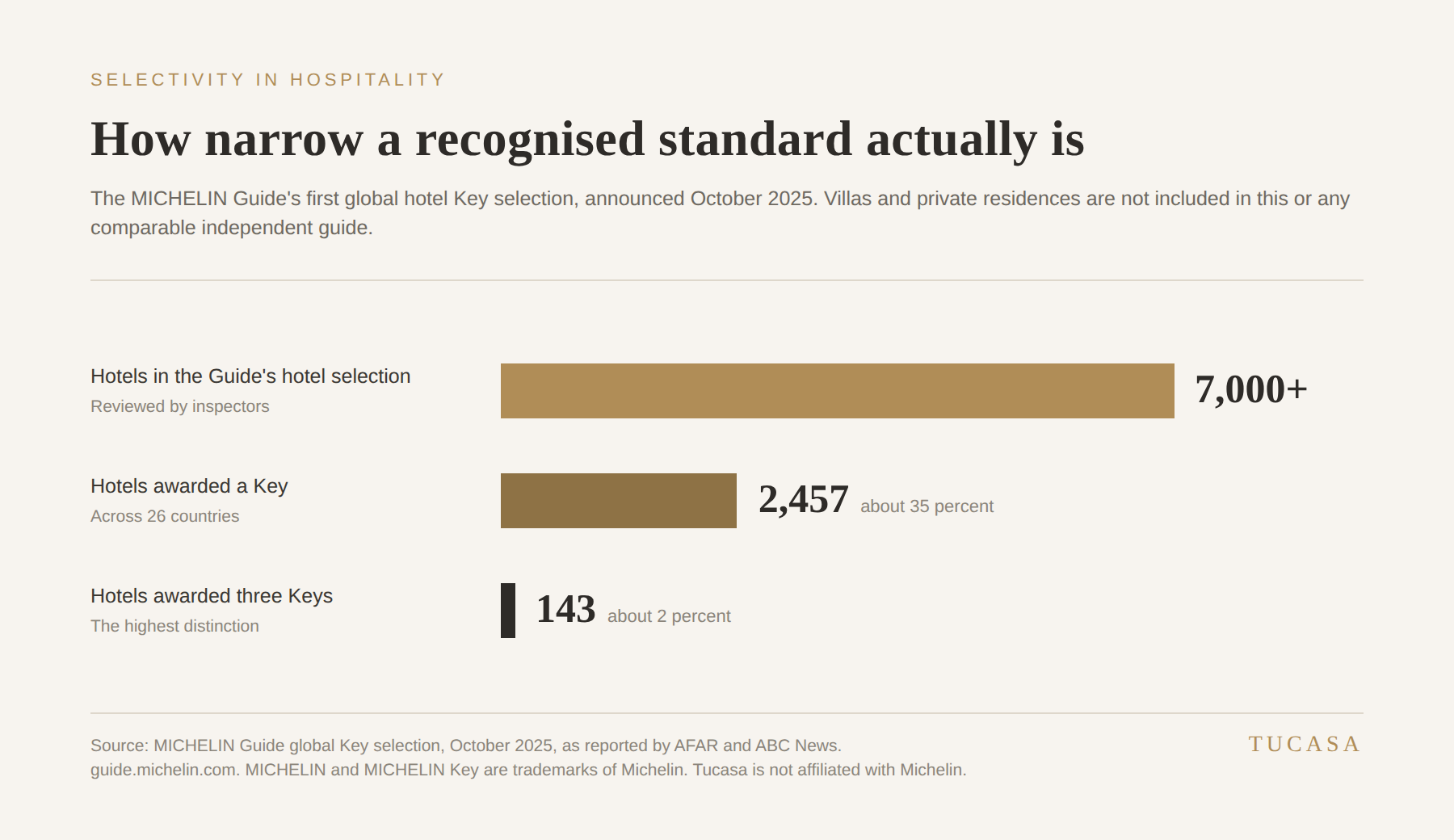
In 2023 the Guide extended that method to accommodation with the MICHELIN Key. As the Guide explains, Keys are awarded on architecture and interior design, service, character, value, and contribution to the surrounding setting. In October 2025 it published its first global Key selection: 2,457 hotels across 26 countries, drawn from a reviewed pool of more than 7,000, with 143 reaching the highest three Key distinction.
Hotels, then, now have an independent standard. Private villas do not. A residence sleeping fourteen, with a resident chef, a butler, and a boat at the dock, can be listed on a major marketplace within an afternoon, described entirely in its owner's words and photographed by whoever the owner hired.
Why Selection Became the Product
The Guide's authority never came from the number of entries. It came from the omissions. Every restaurant printed implied thousands that were visited and left out, and readers understood that the refusals were what they were paying for. Inclusion meant something because exclusion was real.
That inversion is precisely what private villa rental has lacked. Most platforms are paid on volume, so selectivity costs them money: every residence turned away is inventory removed from the shelf. Tucasa runs the other way. Our luxury villa rentals collection is invite only, and fewer than one percent of the residences we review earn a place in it. The refusals are the offering.
The Vetting Gap in Private Villa Rentals
In October 2024 the Federal Trade Commission's final rule banning fake reviews and testimonials took effect, carrying civil penalties for businesses that buy, sell, or suppress consumer reviews. It was necessary. It is also not a standard of excellence. A prohibition on fraud stops a villa from inventing praise. It does not tell you whether the staff are trained, whether the plot next door is under construction, or whether the sea view survives the August haze.
Aggregate ratings compound the gap rather than closing it. A residence rated 4.9 across sixty stays tells you that sixty parties were satisfied, not that the villa meets a defined standard. Restaurant guides solved this by refusing to average opinions and hiring people to form one instead. Villa rental never built the equivalent, and the vocabulary drifted accordingly, until every listing was described as exclusive and the word stopped carrying information.
The stakes are what make the gap uncomfortable. A meal that disappoints costs an evening. A villa that disappoints costs a milestone birthday, a family gathering assembled from four countries, or a private retreat arranged around executives who will not easily reconvene. Guests at this level are not looking for a bargain and are rarely surprised by the invoice. They are looking for certainty, and certainty is the one thing an unvetted listing cannot supply at any figure.
The Four Criteria That Decide
Architecture. Not scale, and not the number of bedrooms. Proportion, materials, and the relationship between interior and landscape. A villa that photographs beautifully and lives badly is disqualified. So is one where the principal suite faces a service road.
Privacy. Measured in sightlines and access, not in acreage. We map what is visible from the pool terrace, who can moor within view, and how close the nearest occupied residence sits in high season rather than in the low season photographs.
Service. Fully staffed means a named team, present, trained, and retained across seasons. We assess how the estate manager handles a request that was never anticipated, because that is the only part of service a booking page cannot describe.
Sense of place. A residence should be legible as belonging where it stands. A finca in Mallorca and a cliffside estate above the Tyrrhenian should not read as the same interior with different weather.
What Rigorous Vetting Looks Like in Practice
Every villa in the collection is visited in person before it is accepted, and the visit is unannounced where that is possible. We stay. We eat what the kitchen produces on an ordinary Tuesday. We test the water pressure on the top floor, the drive from the airport at the hour guests will actually make it, and the noise from the road after midnight. Residences are re-reviewed, and a villa that drifts is removed rather than quietly downgraded.
The result is deliberately small. Across our destination collection, from the cliffs of Uluwatu in Bali to the lemon terraces above Positano, the count is measured in dozens rather than thousands, and it is meant to stay that way. If you are weighing where to begin, our overview of the top villa destinations sets out where private estates genuinely outperform hotels.
There is no MICHELIN Guide for villas. There is a standard, applied by people who visit, and a collection short enough to prove it.
Commonly Asked Questions About a Michelin Guide for Villas
Does the MICHELIN Guide rate private villas?
No. The Guide's selections cover restaurants and, since the introduction of the MICHELIN Key in 2024, hotels. Private villas and residences fall outside its scope, and Michelin has not announced plans to include them.
Is Tucasa affiliated with the MICHELIN Guide?
No. Tucasa is an independent villa collection with no affiliation, endorsement, or association with Michelin, the MICHELIN Guide, or the MICHELIN Key. References on this page are descriptive comparisons only.
What does a MICHELIN Key recognise?
The Key is the Guide's hotel distinction, awarded on a one to three scale following anonymous inspector stays. It assesses architecture and interior design, service, character, value, and how strongly a hotel connects guests to its setting.
How are luxury villas vetted when no guide exists?
It depends entirely on the operator. Open marketplaces rely on owner-supplied descriptions and guest ratings. Curated collections apply their own criteria, so the question worth asking is who inspected the villa, whether they stayed in it, and how many were rejected.
What should I ask before booking a luxury villa rental?
Ask whether anyone from the company has stayed in the villa, when they last visited, which staff are permanent, what sits immediately outside the boundary, and what proportion of reviewed residences the collection declines. The last answer is the most revealing.
MICHELIN, the MICHELIN Guide, and MICHELIN Key are trademarks of Michelin. Tucasa is not affiliated with, endorsed by, or sponsored by Michelin. All references are descriptive and used for comparison only.


