

Article
Can Travel Agents Book Private Villas?

The short version
- Yes. Travel agents and advisors can and do book private villas, and a growing number are building their practice around it.
- The obstacle is rarely client demand. It is access, commission clarity, and who carries the risk when something goes wrong mid stay.
- Villa bookings above $10,000 per night grew 42 percent year over year, according to advisor survey work published in 2026.
- Four routes exist: open marketplaces, villa wholesalers, direct with owners, and curated collections. Only two of them reliably pay commission.
- The most exclusive residences are never listed publicly, which means the route to them is a relationship rather than a search.
- Advisors who want access to off market estates should approach collections directly and establish the relationship before a client asks.
Can Travel Agents Book Private Villas?
Yes, and the mechanics are more straightforward than the category's reputation suggests. What stops most advisors is not permission. It is that private villa rentals sit outside the booking infrastructure the rest of the trade runs on. There is no GDS entry, no standard rate code, no consortia-negotiated amenity. An advisor placing a client in a staffed estate on the Amalfi Coast is doing something closer to brokering than to booking, and the industry has never built the rails for it.
That gap is now costing advisors real revenue, because the demand has moved decisively toward private residences.
The Demand Is Already There
The 2026 Virtuoso Luxe Report surveyed more than 2,400 luxury travel advisors across 58 countries and found the market shifting from what it called FOMO travel toward longer, slower stays in single locations. Villa bookings above $10,000 per night climbed 42 percent year over year. Virtuoso separately projects trips above $50,000 will rise 35 percent across the 2026 to 2027 season.
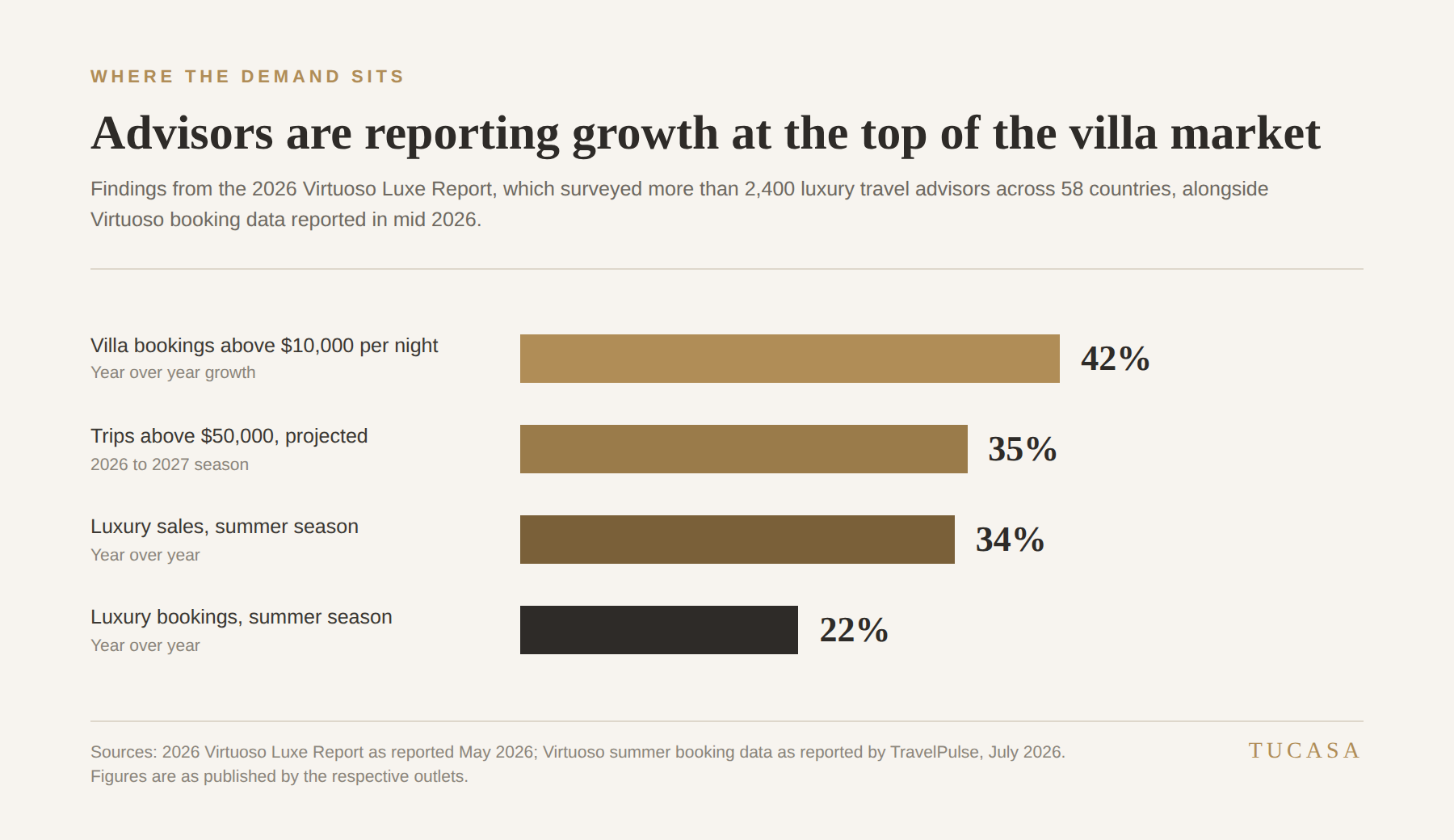
The underlying driver is group composition. Multi-generational travel has returned at scale, and a family of fourteen assembled from three countries is a problem hotels solve badly and estates solve naturally. Forbes reported on the Virtuoso findings in detail, noting that wealthy travellers now prioritise meaning and restoration over display. That preference maps directly onto private residences.
Clients Are Returning to Advisors
The second shift is about the channel itself. After two decades of predictions that booking engines would make the intermediary obsolete, the opposite is happening. The American Society of Travel Advisors counts roughly 310,000 sellers of travel in the United States and projects agency sales will account for 26 percent of the total travel market by 2026. Around 30 percent of advisors report that most of their clients are first time users.
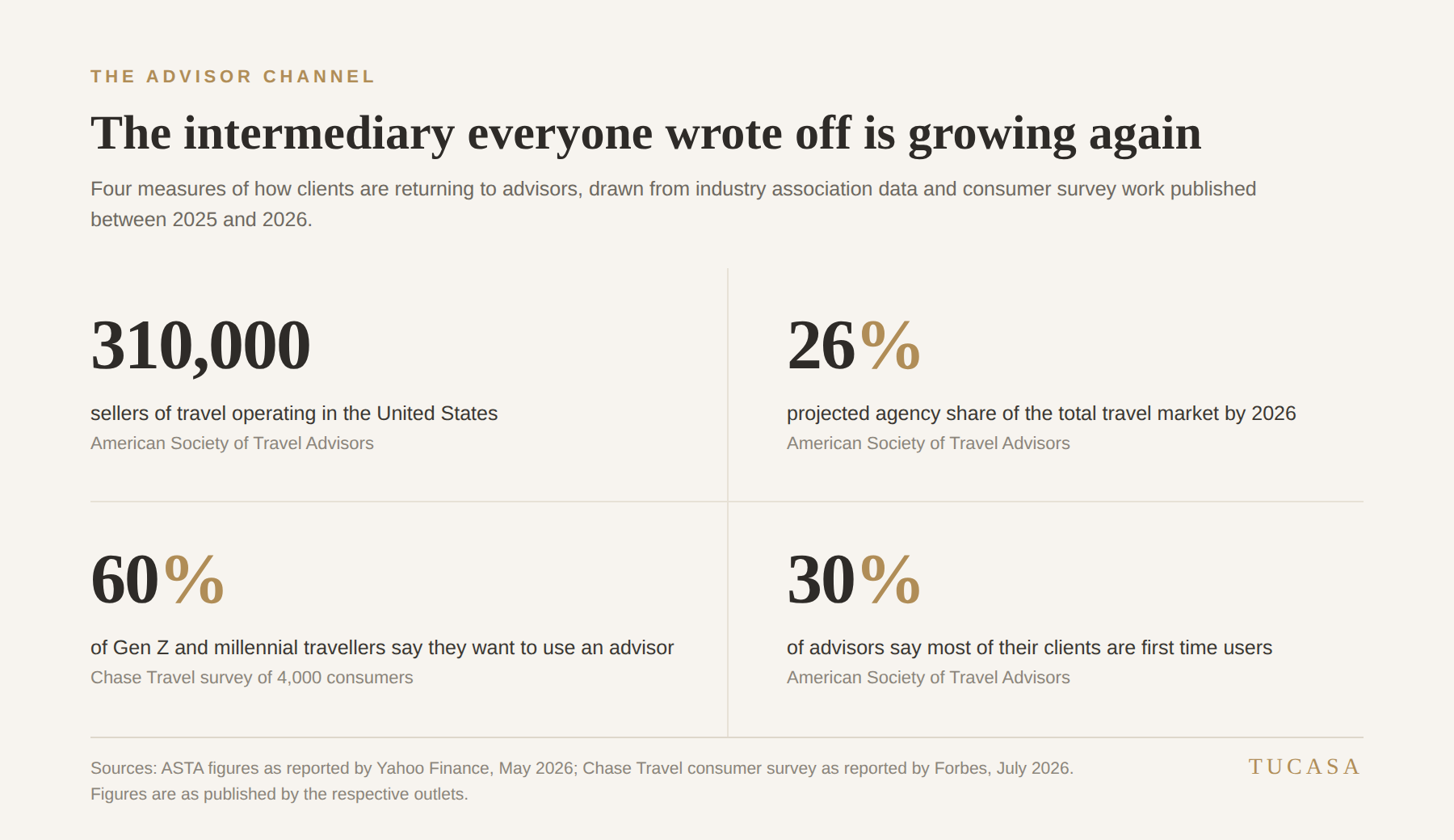
Younger clients are driving much of it. Forbes, reporting on the growth of the advisor platform Fora, cited a Chase Travel survey of more than 4,000 consumers in which 60 percent of younger travellers said they wanted to work with an advisor, with 44 percent reporting that trip planning felt more overwhelming than it used to. The same durability shows in unstable conditions: when nine in ten Virtuoso advisors named geopolitical concerns as the leading factor shaping 2026, the network reported that bookings were not slowing, only shifting in destination and shape.
The Four Routes, and What Each Costs You
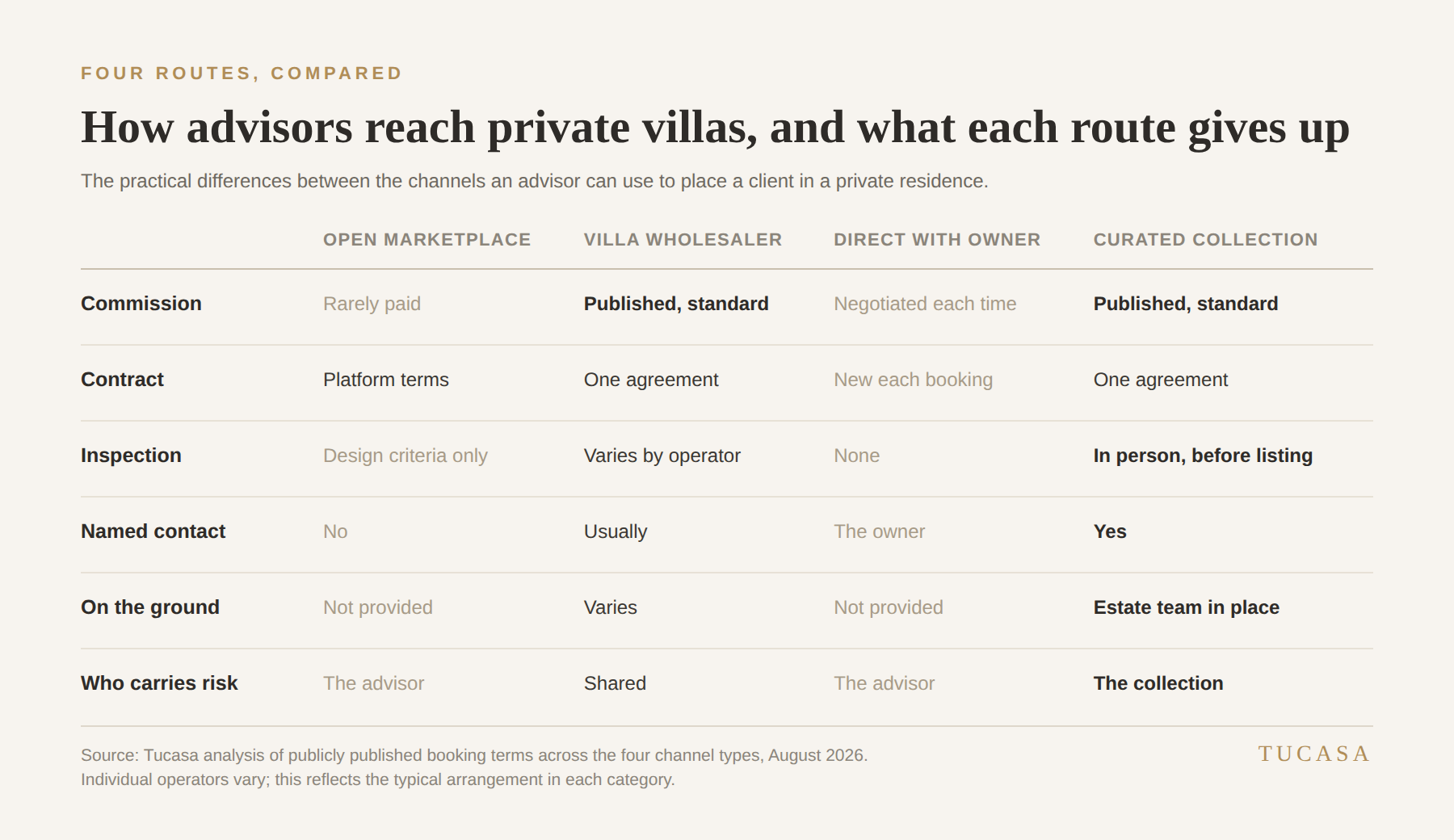
Open marketplaces. Technically available to anyone, and commission is rarely part of the arrangement. Vetting is weighted toward design and equipment rather than service or setting. We have written separately on the practical limits of booking villas through marketplaces, and the short conclusion is that they work well for self-catered stays and poorly for anything an advisor's reputation rests on.
Villa wholesalers. The established trade route. Commission is published, contracts are standardised, and inventory is broad. The trade is that breadth dilutes selectivity, and an advisor is often presenting residences nobody at the wholesaler has personally visited.
Direct with the owner. Occasionally the only route to a genuinely rare estate, and operationally the hardest. Terms are renegotiated every time, commission is uncertain, and liability sits squarely with the advisor.
Curated collections. Inventory is small, inspection happens before a residence is accepted, commission terms are published, and the collection rather than the advisor carries responsibility for the stay.
What Advisors Should Ask Before Placing a Client
The qualifying questions are the same regardless of route. Has anyone from the company stayed in this villa, and when? Which staff are permanent, and which are hired for the week? What sits immediately beyond the boundary in August, rather than in the photography? Who is reachable at eleven at night in the local time zone? What is the commission rate, when is it paid, and is it paid on the full booking or on the accommodation only?
An operator who answers all five quickly is a partner. An operator who deflects on any of them is a listing service. That distinction is worth more than any brochure, and it is the same standard we apply when assessing whether a residence belongs in our own collection. For context on how the category is written about and where coverage falls short, our review of the leading luxury travel magazines is a useful orientation for advisors building destination knowledge.
Where the Rarest Residences Actually Live
Here is the part that matters most, and it is the part least understood outside the trade. The finest private estates in the world are not listed anywhere online. Their owners are principals who do not want their residence indexed, photographed by strangers, or discoverable by anyone with a search bar. These are places let through relationships, quietly, to guests who arrive vouched for. An advisor searching for them will not find them, because being findable is precisely what their owners have paid to avoid.
Our overview of the most exceptional villas worldwide gives a sense of the tier, though the residences that never appear publicly sit further along still.
An Invitation to Advisors
Tucasa was built for exactly this problem. We are an invite only collection of private estates, and fewer than one percent of the residences we review earn a place in it. Every villa is visited in person before acceptance. We stay in it, we eat what the kitchen produces on an ordinary Tuesday, we test the airport drive at the hour guests will actually make it, and we map what is visible from the terrace in high season rather than in the low season photographs.
A meaningful share of our collection has never been listed publicly and never will be. Those residences reach guests through advisors we know, which is the whole reason we want to know more of you. Our luxury villa rentals collection spans Miami, Los Angeles, Aspen, Costa Rica, Ibiza, and a growing European and Caribbean portfolio, with new estates added only as they pass inspection.
What we offer advisors is deliberately simple. Published commission terms with no negotiation required. One agreement rather than a new contract per booking. A named contact who answers, and an estate team present throughout the stay. Client ready materials you can present under your own name. And first access to residences before they are shown anywhere else, which for the off market portion of the collection means the only access there is.
If you have clients who ask for something a resort cannot provide, we would welcome the conversation. Reach out, tell us the shape of your clientele, and we will tell you honestly whether we are the right supplier for it. Relationships in this category take time to build and tend to last, and the advisors who start them before a client asks are the ones holding the keys when the request arrives.
Commonly Asked Questions About Travel Agents Booking Private Villas
Can travel agents book private villas for clients?
Yes. Advisors book private villas through wholesalers, curated collections, direct owner arrangements, and occasionally open marketplaces. The route determines commission, contract terms, and who carries responsibility if the stay goes wrong.
Do villa rentals pay commission to travel advisors?
Curated collections and villa wholesalers typically do, on published terms. Open marketplaces generally do not, and direct owner arrangements vary booking by booking. Always confirm the rate, the payment timing, and whether commission applies to the full booking or accommodation only.
How do travel agents get access to exclusive villas?
By building direct relationships with collections and specialist operators. The most exclusive residences are never listed publicly, so access comes through introduction rather than through search or a booking platform.
Are private villas suitable for advisor clients?
Particularly for groups above eight, for multi-generational travel, and for milestone occasions. Advisor survey data published in 2026 showed villa bookings above $10,000 per night growing 42 percent year over year, concentrated in exactly these use cases.
What are the risks for an advisor booking a villa?
Unverified staffing claims, undisclosed construction or noise nearby, unclear cancellation terms, and no one contactable during the stay. A supplier who inspects residences in person and provides an on the ground team removes most of this exposure.
How far in advance should advisors book villa rentals?
Peak weeks in the Mediterranean and the Caribbean move nine to twelve months out, and festive season inventory in the most sought after markets is effectively spoken for a year ahead. Shoulder season can be secured much closer in.
Do advisors need a consortium to sell private villas?
No. Consortium membership helps with discovery and preferred terms, but most curated collections work with independent advisors directly and publish the same commission terms regardless of affiliation.
How does an advisor start a supplier relationship with a villa collection?
Contact the collection directly, describe your clientele and typical group size, and ask for commission terms, sample contracts, and a site inspection or familiarisation visit. Establish it before a client request arrives, not during one.


